

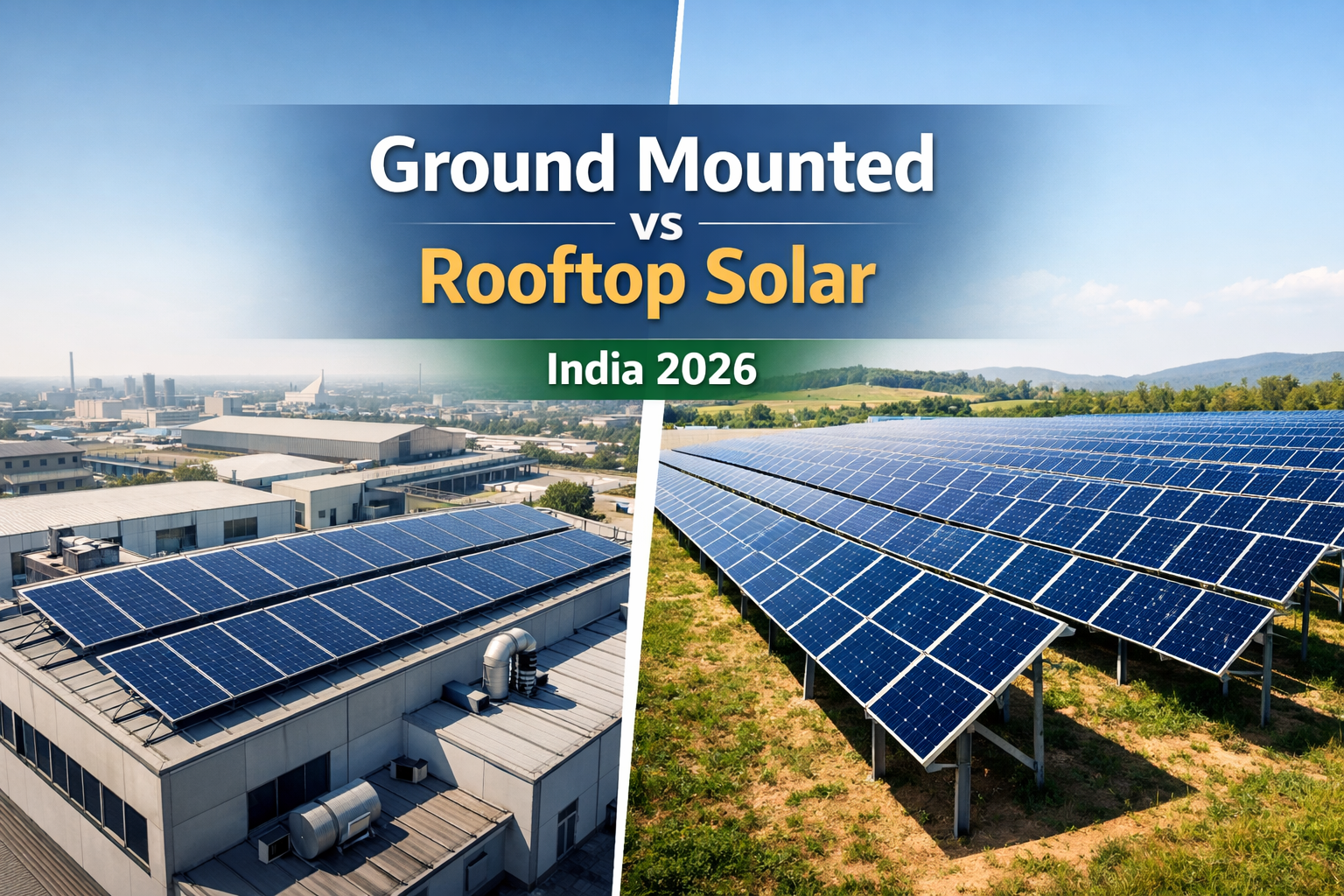
Introduction to Solar Installation Types in India
Ground mounted vs rooftop solar India has become a critical decision point for industries and businesses planning solar investments in 2026. With India’s renewable energy targets exceeding 500 GW by 2030 and increasing electricity tariffs across industrial sectors, solar adoption is no longer optional but a strategic financial decision.
Businesses evaluating solar projects must consider multiple parameters including installation type, cost structure, land availability, system efficiency, and long term return on investment. The choice between rooftop and ground mounted solar systems significantly affects both project feasibility and financial performance.
Rooftop solar systems utilize existing infrastructure and are widely adopted in commercial and industrial facilities located in urban and semi urban areas. In contrast, ground mounted solar systems are designed for large scale energy generation and require dedicated land, making them suitable for industrial plants, solar farms, and utility scale projects.
What is a Rooftop Solar Plant
A rooftop solar plant is a solar photovoltaic system installed on the roof of a building. It converts sunlight into electricity for on site consumption, reducing dependency on grid power and lowering electricity bills.
Rooftop solar systems are commonly used in commercial buildings, manufacturing units, warehouses, and institutional facilities. These systems are typically grid connected and operate under net metering policies, allowing excess electricity to be exported to the grid.
The capacity of rooftop solar systems depends on available roof space and structural load bearing capacity. Industrial rooftops can support installations up to 1 MW in some cases, but most systems range between 50 kW and 500 kW.
What is a Ground Mounted Solar Plant
Ground mounted solar plants are installed on open land using fixed or tracking mounting structures. These systems are designed for optimal solar exposure, allowing better tilt angle adjustment and higher energy generation efficiency.
Ground mounted solar systems are typically used for large scale industrial projects and utility level solar generation. They are suitable for organizations with access to land and higher power consumption requirements.
These systems can be expanded easily, making them ideal for projects exceeding 1 MW capacity. They also allow better airflow and cooling, which improves panel efficiency over time.
Key Differences Between Ground Mounted vs Rooftop Solar India
| Parameter | Rooftop Solar | Ground Mounted Solar |
|---|---|---|
| Installation Location | Building rooftop | Open land |
| Capacity Limit | Limited by roof space | Highly scalable |
| Installation Complexity | Moderate | High |
| Efficiency | Moderate | Higher due to optimized tilt |
| Maintenance Access | Limited | Easy |
| Land Requirement | Not required | Required |
| Expansion Capability | Restricted | Flexible |
This comparison highlights that rooftop solar is space efficient while ground mounted solar is performance oriented.
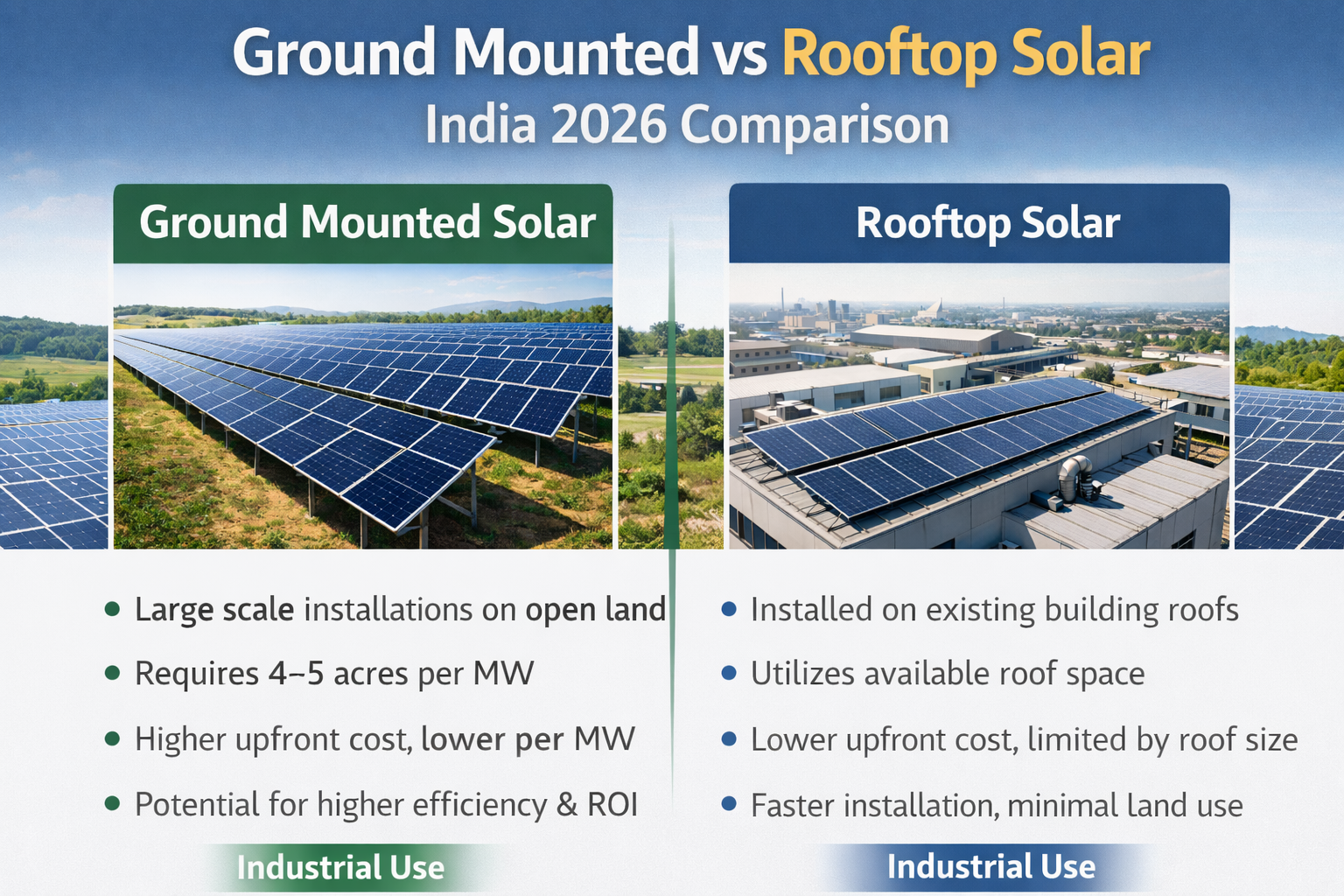
Cost Comparison Rooftop vs Ground Mounted Solar in India
| Cost Component | Rooftop Solar | Ground Mounted Solar |
|---|---|---|
| Average Cost per kW | 45,000 to 65,000 INR | 60,000 to 85,000 INR |
| Mounting Structure | Basic rooftop structure | Heavy duty ground structure |
| Civil Work | Minimal | Significant |
| Installation Time | Faster | Longer |
| Maintenance Cost | Moderate | Lower over time |
In 2026, cost trends show that ground mounted solar systems are more economical for large scale installations due to economies of scale, even though they require higher initial infrastructure investment.
Land Requirement and Space Considerations
- Land availability is a major differentiating factor between rooftop and ground mounted solar systems.
- Rooftop solar systems utilize existing building space, making them ideal for urban industries where land is expensive or unavailable. However, roof size and structural limitations restrict system capacity.
- Ground mounted solar systems require approximately 4 to 5 acres of land per MW. This makes them suitable for industrial zones, rural areas, and large manufacturing units with access to unused land.
Efficiency and Energy Generation Comparison
- Ground mounted solar systems generally achieve higher efficiency compared to rooftop installations. This is primarily due to:
- Optimal tilt angle and orientation
- Reduced shading losses
- Better ventilation and cooling
- On average, ground mounted systems can generate 5 percent to 10 percent more electricity annually compared to rooftop systems of similar capacity.
ROI and Payback Period Analysis
| Factor | Rooftop Solar | Ground Mounted Solar |
|---|---|---|
| Payback Period | 4 to 6 years | 3 to 5 years |
| ROI | 15 to 20 % | 18 to 25 % |
| Lifetime | 25 years or more | 25 years or more |
Ground mounted solar systems provide better returns for high capacity projects, while rooftop systems offer faster deployment and immediate savings.
Advantages and Disadvantages of Rooftop Solar Systems
| Advantages | Disadvantages |
|---|---|
| Utilizes existing infrastructure without land requirement | Limited capacity due to roof space |
| Lower initial investment compared to large scale systems | Structural constraints and load limitations |
| Faster installation and commissioning | Maintenance challenges due to accessibility |
| Suitable for urban and industrial buildings | Performance affected by shading and orientation |
| Eligible for net metering benefits |
Advantages and Disadvantages of Ground Mounted Solar Systems
| Advantages | Disadvantages |
|---|---|
| High scalability for large energy demand | Requires significant land area |
| Better efficiency due to optimized design | Higher initial setup cost |
| Easy maintenance and cleaning access | Land acquisition and regulatory challenges |
| Flexible system expansion capability | Additional infrastructure and civil work required |
| Suitable for industrial and utility scale projects |
Best Use Cases Which Solar Option is Right for You
- Rooftop solar is best suited for commercial and industrial buildings where roof space is available and energy consumption is moderate.
- Ground mounted solar is ideal for industries with large energy requirements, access to land, and long term investment planning. It is also preferred for solar farms and utility scale power generation.
Government Policies and Subsidy Impact
Solar adoption in India is supported by multiple government initiatives and regulatory frameworks.
You should reference official data and policies from the Ministry of New and Renewable Energy and Central Electricity Authority.
Challenges and Practical Limitations in India
- Rooftop solar systems face challenges related to roof ownership, structural safety, and shading issues in dense urban environments.
- Ground mounted solar systems face challenges such as land acquisition delays, environmental clearances, and grid connectivity constraints in remote area.
Why Choose Akuntha Projects for Solar Rooftops & Solar EPC Solutions
Final Thoughts
The decision between ground mounted vs rooftop solar India depends on several factors including available space, project size, budget, and long term energy goals. Rooftop solar systems are ideal for businesses with limited space and immediate energy needs, while ground mounted solar systems provide better performance and scalability for large industrial projects.
A well planned solar investment not only reduces energy costs but also enhances sustainability and operational efficiency. Choosing the right installation type with expert guidance ensures maximum benefits from solar energy.
Frequently Asked Questions
What is the difference between rooftop and ground mounted solar systems in India?
Rooftop solar systems are installed on buildings and are suitable for limited space, while ground mounted systems are installed on land and provide higher scalability and efficiency for large projects.
Which solar system is more cost effective in India?
Rooftop solar has lower upfront costs, but ground mounted solar is more cost effective for large scale installations due to better efficiency and economies of scale.
How much land is required for a ground mounted solar plant?
Typically, 4 to 5 acres of land are required per MW of solar installation depending on system design and layout.
What is the ROI of solar projects in India?
Solar projects in India generally offer a return on investment between 15 percent and 25 percent with a payback period of 3 to 6 years.
Which solar system is better for industrial use?
Ground mounted solar systems are more suitable for industrial use due to higher capacity, better performance, and scalability.
