

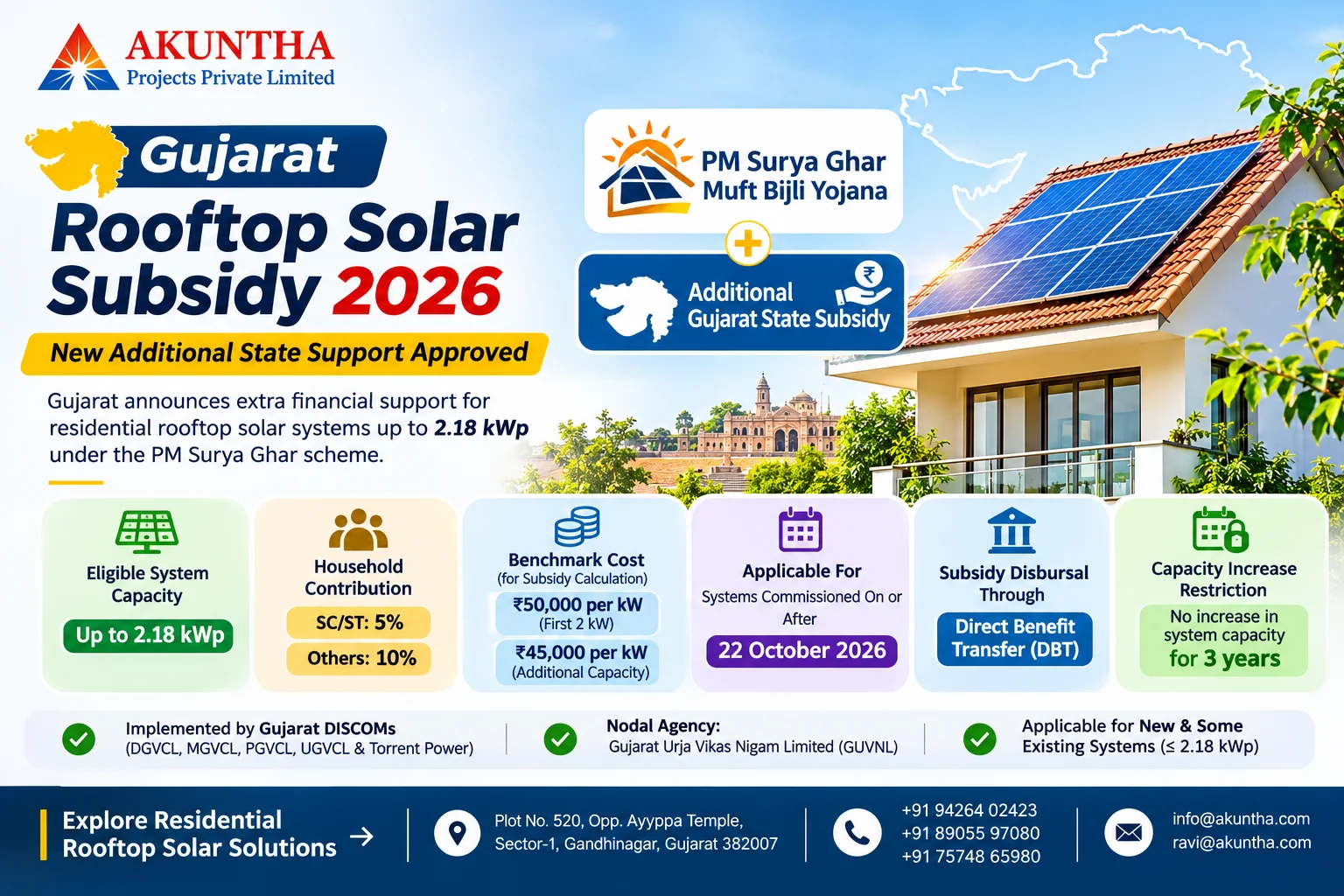
The Gujarat rooftop solar subsidy 2026 announcement introduces additional state financial assistance for eligible residential consumers installing rooftop solar systems under the PM Surya Ghar: Muft Bijli Yojana. The decision is intended to make residential solar more affordable by reducing the share of the installation benchmark cost that households must contribute themselves.
Reported on 22 October 2026, the state government’s decision provides additional support alongside the Central Financial Assistance available under the national scheme. Under the new arrangement, eligible residential consumers from categories other than Scheduled Castes and Scheduled Tribes contribute 10% of the applicable benchmark cost, while eligible SC and ST households contribute 5%. The remaining eligible amount is covered through central and state assistance, subject to the applicable rules.
The new support is linked to residential rooftop solar systems with a total installed DC capacity of up to 2.18 kilowatt peak (kWp). The reported implementation conditions also include a commissioning date requirement and restrictions on adding further rooftop capacity after receiving the benefit
For households considering solar, the announcement is important because the initial installation cost is often a major barrier to adoption. Additional state support can reduce this barrier, particularly for families who want to generate electricity at home but have limited funds available for the initial investment.
However, the subsidy should not be interpreted as a universal offer for every solar installation. Capacity limits, commissioning dates, residential eligibility and other conditions must be checked before proceeding.
What Is the New Gujarat Rooftop Solar Subsidy?
The Gujarat government has approved additional financial support for eligible residential rooftop solar installations under the PM Surya Ghar: Muft Bijli Yojana.
The central scheme already provides financial assistance for eligible residential rooftop solar systems. Gujarat’s additional subsidy is intended to reduce the remaining eligible installation cost that households would otherwise need to pay.
Under the reported arrangement, the household contribution is limited to 10% of the applicable benchmark cost for general residential consumers and 5% for eligible SC and ST consumers. The state government covers the remaining eligible amount after accounting for central assistance and the consumer’s prescribed contribution.
The scheme is intended to improve affordability for households that want to adopt rooftop solar without bearing a large share of the installation cost themselves.
According to reports following the state cabinet decision, the initiative is expected to benefit more than 3 lakh families, with estimated state expenditure of approximately ₹1,000 crore. These figures represent the reported programme target and estimated allocation, not a guarantee that every household will receive the subsidy.
The announcement is linked to the broader PM Surya Ghar: Muft Bijli Yojana, the national residential rooftop solar programme.
Key Highlights of the Gujarat Solar Subsidy 2026
The following table summarises the main reported features of the new policy.
| Policy Detail | Reported Provision |
|---|---|
| State | Gujarat |
| Announcement | October 2026 |
| Linked national programme | PM Surya Ghar: Muft Bijli Yojana |
| Eligible consumer type | Residential consumers, subject to scheme conditions |
| Maximum installed DC capacity | 2.18 kWp |
| General residential consumer contribution | 10% of the applicable benchmark cost |
| SC/ST residential consumer contribution | 5% of the applicable benchmark cost |
| Central assistance | Applicable PM Surya Ghar Central Financial Assistance |
| Additional state support | Remaining eligible cost after central assistance and consumer contribution |
| Reported implementation date | Systems commissioned on or after 22 October 2026 |
| Payment method | Direct Benefit Transfer, according to published reporting |
| Reported expected beneficiaries | More than 3 lakh households |
| Reported estimated state expenditure | Approximately ₹1,000 crore |
| Nodal agency | Gujarat Urja Vikas Nigam Limited (GUVNL) |
How Does the Additional State Subsidy Work?
The new arrangement combines two sources of government assistance.
The first is Central Financial Assistance under PM Surya Ghar. The second is the additional state subsidy approved by Gujarat.
The household contributes the prescribed percentage of the applicable benchmark cost. Central assistance is then accounted for, and the state covers the remaining eligible amount according to the scheme’s calculation.
The general calculation can be represented as:
State Subsidy = Eligible Benchmark Cost − Applicable Central Assistance − Prescribed Household Contribution
This is a simplified representation of the reported funding arrangement. The actual calculation must follow the official government resolution and applicable scheme guidelines.
Subsidy Structure by Consumer Category
| Consumer Category | Household Contribution | Government Support | General and other eligible residential consumers | General and other eligible residential consumers | Central assistance plus additional state subsidy |
|---|---|---|
| Eligible SC households | 5% of applicable benchmark cost | Central assistance plus additional state subsidy |
| Eligible ST households | 5% of applicable benchmark cost | Central assistance plus additional state subsidy |
The higher assistance for SC and ST households is intended to reduce the initial financial barrier for eligible families.
How Gujarat Calculates the Additional Rooftop Solar Subsidy?
The additional Gujarat subsidy is calculated using the applicable benchmark cost, the Central Financial Assistance available under the PM Surya Ghar: Muft Bijli Yojana, and the contribution required from the household. The benchmark cost is used for calculating eligible financial support; it should not automatically be treated as the final quotation provided by a solar installer.
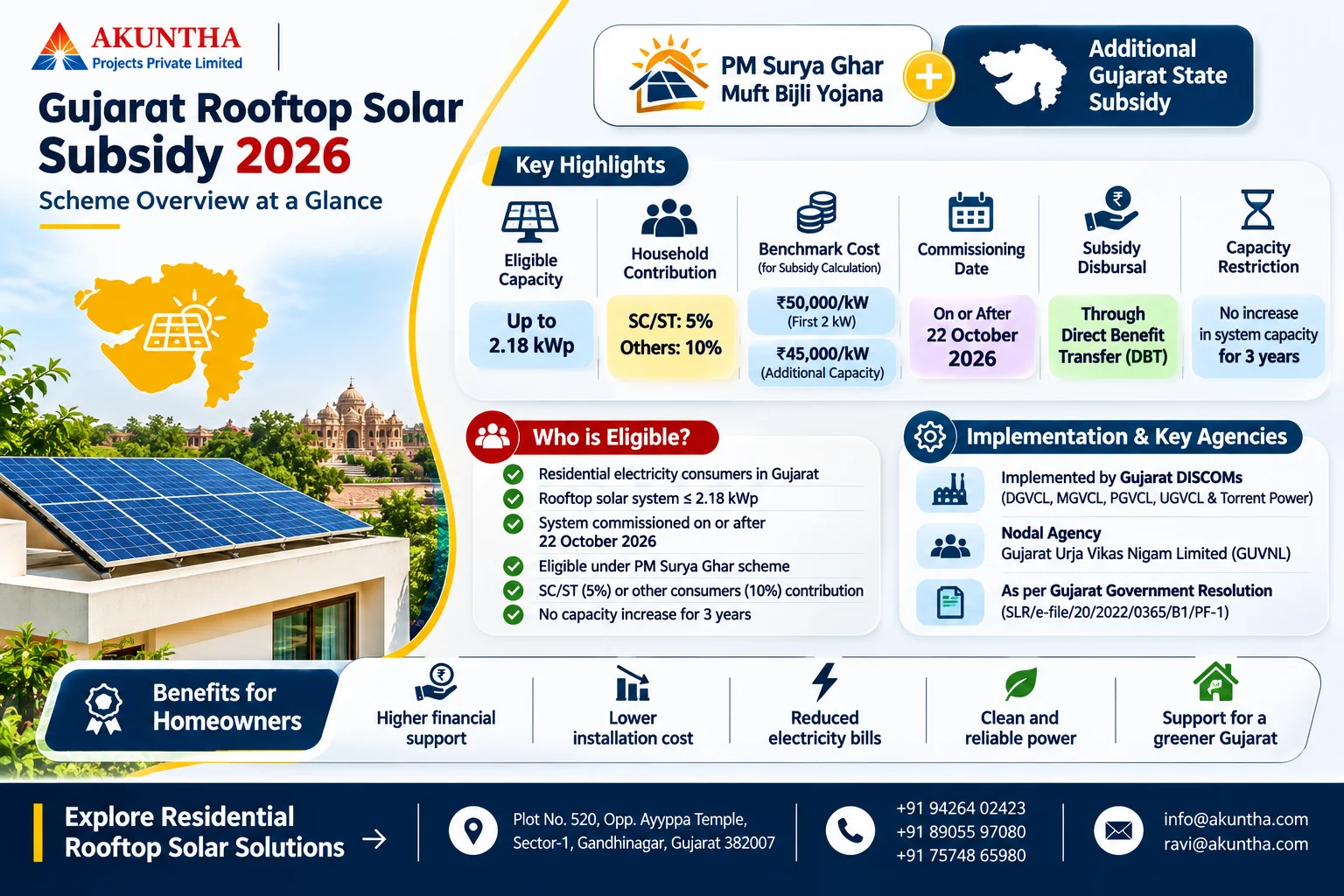
The reported benchmark rates are ₹50,000 per kW for the first 2 kW of capacity and ₹45,000 per kW for any additional eligible capacity. The state subsidy covers the remaining eligible amount after accounting for central assistance and the applicable household contribution.
The household contribution differs by category. Scheduled Caste and Scheduled Tribe households contribute 5% of the applicable benchmark cost, while other residential consumers contribute 10%. The exact subsidy amount depends on the eligible system, the applicable central assistance and the conditions of the Gujarat policy.
| Policy component | Details |
|---|---|
| First 2 kW benchmark cost | ₹50,000 per kW |
| Additional eligible capacity benchmark cost | ₹45,000 per kW |
| SC/ST household contribution | 5% of the applicable benchmark cost |
| Other residential household contribution | 10% of the applicable benchmark cost |
| Gujarat state support | Covers the remaining eligible amount after central assistance and household contribution |
| Maximum capacity under this additional support | 2.18 kWp, subject to the policy conditions |
How Much Does a Household Need to Pay?
The amount a household contributes depends on the applicable benchmark cost and the installed capacity.
News reports following the cabinet decision have provided illustrative examples for 1 kW and 2 kW systems. These examples are useful for understanding the effect of the subsidy, but they should be treated as reported illustrations rather than guaranteed prices for every installation.
Illustrative Household Contribution for a 1 kW System
One reported example uses a benchmark installation cost of ₹54,000 for a 1 kW system.
| Cost Component | General Household | Eligible SC/ST Household |
|---|---|---|
| Illustrative benchmark cost | ₹54,000 | ₹54,000 |
| Central assistance in the reported example | ₹32,400 | ₹32,400 |
| Household contribution | ₹5,400 | ₹2,700 |
| Additional state subsidy in the reported example | ₹16,200 | ₹18,900 |
| Total government assistance | ₹48,600 | ₹51,300 |
The example shows how the lower household contribution for eligible SC and ST consumers changes the distribution of the installation cost.
Illustrative Household Contribution for a 2 kW System
A separate reported example uses a benchmark installation cost of ₹1,07,200 for a 2 kW system.
| Cost Component | General Household | Eligible SC/ST Household |
|---|---|---|
| Illustrative benchmark cost | ₹1,07,200 | ₹1,07,200 |
| Central assistance in the reported example | ₹62,800 | ₹62,800 |
| Household contribution | ₹10,720 | ₹5,360 |
| Additional state subsidy in the reported example | ₹33,600 | ₹38,960 |
| Total government assistance | ₹96,400 | ₹1,01,760 |
Cost verification is essential: Published reports use different benchmark figures and describe the maximum eligible capacity differently in some places. The new policy’s reported limit is 2.18 kWp. Before publishing a final customer quotation or applying the examples to a real installation, verify the official state resolution and the current subsidy calculation through the authorised programme channel.
An installer quotation can also include equipment or services that are not part of the eligible benchmark cost. Households should therefore compare the approved subsidy calculation with the actual quotation rather than assuming the subsidy will cover every item.
What Is the Difference Between Central and State Solar Subsidies?
Central and state subsidies are separate sources of financial assistance, even when they support the same residential solar installation.
The central subsidy is administered under PM Surya Ghar and follows the national scheme’s eligibility and payment conditions. Gujarat’s additional subsidy is intended to reduce the remaining eligible cost for qualifying residential consumers in the state.
| Feature | Central Subsidy | Gujarat State Subsidy |
|---|---|---|
| Funding authority | Government of India | Government of Gujarat |
| Linked programme | PM Surya Ghar: Muft Bijli Yojana | Additional state support linked to the programme |
| Primary purpose | Support eligible residential rooftop solar installations | Further reduce the eligible household contribution |
| Amount | Based on central scheme rules and applicable capacity | Based on the state policy and central assistance |
| Eligibility | National scheme requirements | State policy requirements and qualifying installation conditions |
The two forms of assistance should not be treated as interchangeable. Households must meet the relevant requirements for both the central and state components.
For details of the national scheme, visit the official PM Surya Ghar portal.
Who Is Eligible for the Gujarat Rooftop Solar Subsidy?
The new support is intended for eligible residential consumers installing rooftop solar systems under the applicable programme.
The main reported conditions are as follows.
1. Residential Electricity Consumer
The policy concerns residential rooftop solar systems. It should not be presented as an equivalent subsidy for factories, commercial buildings or industrial rooftop solar installations.
2. Installed DC Capacity Within the Limit
The total installed DC capacity must not exceed 2.18 kWp under the reported state subsidy conditions.
A system that exceeds the prescribed capacity limit should not be assumed to qualify simply because its AC inverter rating is lower.
3. Commissioning Date
The additional subsidy reportedly applies to eligible systems commissioned on or after 22 October 2026 – EPCD/BUD/e-file/20/2025/2435/B1
Consumers should verify the recognised commissioning date in their application and supporting records.
4. Applicable Central Scheme Conditions
The installation must satisfy the relevant requirements of PM Surya Ghar and the state implementation framework.
5. Required Documentation
The consumer should keep the electricity connection details, identity and category documents where applicable, bank details, installation records and other documents requested through the official application process.
The official state resolution and authorised portal should be checked for the complete eligibility checklist. The conditions summarised here are based on published reporting and should not replace the official rules.
Commissioning Date and System Capacity Requirements
The additional Gujarat subsidy is reported to apply to eligible residential rooftop solar systems commissioned on or after 22 October 2026, with installed DC capacity not exceeding 2.18 kWp. Households should verify their commissioning documentation and confirm that their installation satisfies the conditions of the applicable state resolution before assuming that they qualify.
The 2.18 kWp threshold is an important eligibility condition. A household should not assume that a larger rooftop solar system qualifies for this particular additional state subsidy simply because it is eligible for central assistance under PM Surya Ghar.
The policy also reportedly restricts beneficiaries from increasing their rooftop solar capacity for three years from the installation date. This condition should be considered before choosing the initial system size, particularly by households that may want to expand their systems later.
What Is the 2.18 kWp Capacity Limit?
The 2.18 kWp limit is one of the most important details of the Gujarat rooftop solar subsidy.
Kilowatt peak, written as kWp, describes the rated direct-current capacity of a solar photovoltaic array under standard test conditions. It is not the same as the amount of electricity generated each month.
The reported state subsidy framework sets a maximum installed DC capacity of 2.18 kWp. A system exceeding that limit is not automatically eligible for the additional state support.
This limit matters when selecting solar modules, deciding how many panels to install and determining whether an existing installation can be expanded under the programme.
For example, a homeowner should not assume that a 3 kWp installation qualifies merely because the system is intended for residential use. The published state conditions specifically identify the 2.18 kWp ceiling.
The final system configuration should be confirmed with an authorised installer and checked against the official scheme conditions before procurement.
What Are the Three Year Capacity Addition Restrictions?
Published reports on the new Gujarat subsidy state that beneficiaries receiving the additional assistance will not be permitted to add further rooftop solar capacity for three years from the installation date.
This condition is important for households that expect their electricity consumption to increase in the near future.
For example, a family planning to purchase an electric vehicle, install additional air conditioning or expand its household electricity use should consider its likely future demand before finalising the solar system.
Installing the largest system possible is not always the best financial decision, but choosing a system that is too small may create limitations if capacity cannot be increased during the restriction period.
Households should therefore assess their electricity bills, daytime consumption, roof space and likely future requirements before selecting the system capacity.
The exact application of the three year condition should be verified against the official resolution, particularly for households with an existing installation.
Can Existing Rooftop Solar Consumers Apply?
Published reporting indicates that consumers who previously installed a rooftop solar system under an earlier programme with a capacity below the new limit may be able to apply for additional assistance for a further installation, provided the cumulative installed capacity remains within 2.18 kWp and the other conditions are met.
This provision could be relevant to households that already have a smaller rooftop solar installation.
However, eligibility should not be assumed solely on the basis of the existing system’s capacity. The consumer should verify the previous installation records, the recognised installed DC capacity and the rules governing additional installations.
Before ordering new modules or modifying an existing system, check the applicable instructions through the SURYA Gujarat rooftop solar portal and the relevant distribution company.
How Will the Subsidy Be Paid?
According to published reports, the additional state assistance will be transferred directly to eligible beneficiaries’ bank accounts through Direct Benefit Transfer (DBT).
The reported implementation framework provides for the additional state subsidy to be transferred to eligible beneficiaries through Direct Benefit Transfer (DBT). Gujarat’s electricity distribution companies are involved in administering the process, while Gujarat Urja Vikas Nigam Limited (GUVNL) acts as the nodal agency for fund management and allocation. The reported distribution companies include DGVCL, MGVCL, PGVCL, UGVCL and Torrent Power.
Households should keep their bank details, electricity consumer information and solar installation documents consistent across the relevant records. They should also follow the official application and verification process applicable to their electricity distribution company.
The subsidy should not be described as an automatic discount from every installer. Eligibility, verification and payment must follow the applicable scheme requirements.
The distribution companies reported as participating in the implementation include:
| Distribution Company | Abbreviation |
|---|---|
| Dakshin Gujarat Vij Company Limited | DGVCL |
| Madhya Gujarat Vij Company Limited | MGVCL |
| Paschim Gujarat Vij Company Limited | PGVCL |
| Uttar Gujarat Vij Company Limited | UGVCL |
| Torrent Power | Private distribution licensee |
Gujarat Urja Vikas Nigam Limited (GUVNL) has been designated as the nodal agency responsible for managing and allocating the state subsidy funds to the distribution companies.
Consumers should ensure that their bank details and application information are accurate. Incorrect account information or incomplete documentation can create problems with subsidy processing.
The precise application, verification and disbursement stages should be checked with the relevant distribution company or official portal. Published reports do not establish a guaranteed date on which every eligible household will receive the additional state subsidy.
How to Apply for Rooftop Solar Subsidy in Gujarat?
Homeowners should use the official application channels rather than relying solely on advertisements or informal claims about the subsidy.
The following is a practical starting process. The exact steps and documents should be confirmed through the current programme instructions.
Step 1: Check Residential Eligibility
Confirm that the electricity connection and proposed installation fall within the residential scheme’s scope.
Review the applicable capacity limit and commissioning date conditions.
Step 2: Review Your Electricity Consumption
Check recent electricity bills to understand household consumption. Consider whether most of the electricity is used during daylight hours and whether the proposed system is appropriate for the household.
Step 3: Check Rooftop Suitability
Assess available roof area, shading, structural condition, access and the proposed module arrangement.
A technical site assessment can help determine whether the proposed system can be installed safely.
Step 4: Use the Official Application Channel
Visit the SURYA Gujarat portal to review Gujarat’s rooftop solar application guidance, installer requirements and relevant documentation.
For the national scheme, visit the PM Surya Ghar portal.
Step 5: Select an Authorised Installer
Check the current installer list and obtain a quotation. Confirm the system’s proposed DC capacity and make sure the installation is compatible with the subsidy conditions.
Step 6: Confirm the Subsidy Calculation
Ask for a written breakdown showing the benchmark cost, central assistance, additional state subsidy and household contribution.
Do not rely only on a verbal promise that the government will pay a particular amount.
Step 7: Complete Installation and Required Verification
Follow the prescribed installation, inspection, metering and commissioning process.
Keep invoices, commissioning records and application acknowledgements.
Step 8: Verify the Subsidy Status
Use the authorised portal or contact the relevant distribution company to check the status of the application and payment.
The steps above are a practical guide, not a replacement for the latest official application procedure. The state subsidy is subject to the applicable government resolution and implementation instructions.
What Is PM Surya Ghar: Muft Bijli Yojana?
PM Surya Ghar: Muft Bijli Yojana is the Government of India’s residential rooftop solar programme. Its stated objective is to support rooftop solar adoption among one crore households, with a total scheme outlay of ₹75,021 crore.
The central scheme provides Central Financial Assistance for eligible residential rooftop solar systems. The subsidystructure is linked to installed capacity and the applicable scheme conditions, with central assistance capped at the prescribed capacity limit.
The programme also aims to make residential solar more accessible through measures such as financing support and approved implementation models.
The Gujarat decision adds a state level affordability measure for qualifying households. Rather than replacing the central scheme, the additional assistance is designed to reduce the remaining eligible cost after central assistance and the household’s prescribed contribution have been taken into account.
For the central scheme’s official objectives and assistance structure, consult the Prime Minister’s Office announcement on PM Surya Ghar.
Why Is Gujarat Providing Additional Solar Support?
The initial investment required for rooftop solar can prevent some households from adopting the technology, even when the system could reduce their reliance on grid electricity.
The additional subsidy is designed to address this financial barrier by limiting the eligible household contribution to a small share of the applicable benchmark cost.
The policy also gives additional support to SC and ST households, whose prescribed contribution is lower than that of other eligible residential consumers.
According to the reported cabinet announcement, the programme is expected to support more than 3 lakh families, with estimated state expenditure of around ₹1,000 crore.
This is a significant policy intervention because residential solar adoption depends not only on the long term value of the electricity generated but also on whether households can afford the initial installation.
The state support may improve access for eligible consumers, but actual uptake will also depend on awareness, installer availability, application processing, technical feasibility and the consumer’s electricity consumption profile.
What Are the Benefits for Gujarat Households?
Lower Initial Installation Cost
The most direct benefit is a lower prescribed household contribution. For qualifying systems, eligible consumers contribute 10% of the applicable benchmark cost, while eligible SC and ST households contribute 5%.
Greater Access to Residential Solar
Reducing the upfront cost can make rooftop solar more accessible to households that previously found the investment difficult to afford.
Potential Electricity Bill Savings
Solar generation can reduce the amount of electricity purchased from the grid. The actual saving depends on system output, household consumption, tariff structure, self-consumption and applicable export or net metering arrangements.
Better Use of Rooftop Space
Residential rooftops can be used to generate electricity without requiring a separate parcel of land for the solar installation.
Support for Renewable Energy Adoption
The policy can encourage more households to consider distributed solar generation, contributing to the wider adoption of renewable energy in Gujarat.
However, subsidy availability does not guarantee zero electricity bills. Fixed charges, electricity consumed outside solar generation hours, system performance and applicable billing rules can affect the final bill.
What Should Homeowners Check Before Installing Solar?
Before committing to a system, homeowners should evaluate the installation as a technical and financial decision rather than focusing only on the subsidy.
First, review recent electricity bills and estimate typical monthly consumption. The proposed system should be suitable for the household’s consumption pattern and available roof space.
Second, confirm the total installed DC capacity. The additional state subsidy has a reported ceiling of 2.18 kWp, so the proposed configuration should be checked carefully.
Third, review the quotation. It should clearly distinguish the system cost, applicable benchmark cost, central assistance, additional state subsidy and the household’s payable amount.
Fourth, verify the installer’s authorisation and the applicable registration, inspection, metering and commissioning requirements.
Finally, review the conditions concerning commissioning dates and future capacity additions. Households should understand the restrictions before making a decision that may affect future expansion.
What Does the Subsidy Mean for Solar Adoption in Gujarat?
Gujarat already has a substantial residential rooftop solar market. The additional state subsidy is intended to make participation more affordable for eligible households, particularly those who may have been unable to meet the initial installation cost.
The policy also illustrates how state governments can complement national renewable energy programmes with targeted support for local consumers.
The actual effect will depend on implementation. Clear eligibility rules, accessible application procedures, reliable installers and timely subsidy processing will be important for translating the announcement into completed installations.
The 2.18 kWp capacity limit also means that the policy is targeted towards smaller residential systems rather than every possible rooftop solar configuration. Households considering larger systems should not assume that the additional state support will apply to their entire installation.
Consumers should check the official scheme instructions before purchasing equipment or signing an installation agreement.
Why Choose Akuntha Projects for Solar Installation & Solar EPC Solutions?
Choosing a solar provider involves more than comparing the advertised system price. A suitable installation requires proper site assessment, system design, equipment selection, electrical integration, commissioning and ongoing maintenance.
Akuntha Projects provides solar EPC and related electrical infrastructure services. For consumers exploring solar solutions, understanding the technical requirements and selecting a system appropriate to the premises are important parts of the decision.
For broader information about solar project engineering and implementation, explore the company’s solar EPC solutions.
For information about rooftop system installations, visit the rooftop solar installation solution.
For longer term system performance and maintenance considerations, read about solar operation and maintenance services.
Conclusion
The Gujarat rooftop solar subsidy 2026 announcement introduces additional state support for eligible residential consumers installing rooftop solar systems under PM Surya Ghar: Muft Bijli Yojana.
Under the reported framework, eligible general residential consumers contribute 10% of the applicable benchmark cost, while eligible SC and ST households contribute 5%. The state covers the remaining eligible cost after accounting for central assistance and the prescribed household contribution.
The reported maximum installed DC capacity is 2.18 kWp, and the support applies to eligible systems commissioned on or after 22 October 2026. Published reports also describe restrictions on adding further rooftop capacity for three years from installation.
The state has estimated that the initiative will benefit more than 3 lakh families, with expenditure of approximately ₹1,000 crore. The final benefit available to an individual household depends on the official implementation conditions, applicable benchmark cost, central assistance and installation eligibility.
For homeowners, the practical next step is to review the official scheme conditions, check the proposed system capacity, obtain a transparent quotation and complete the application through the authorised channels.
The additional support can make residential rooftop solar more affordable, but households should verify eligibility and the final subsidy calculation before committing to installation.
Frequently Asked Questions About Gujarat Rooftop Solar Subsidy 2026
Is the additional Gujarat rooftop solar subsidy available for systems larger than 2.18 kWp?
The reported additional state subsidy applies to eligible residential rooftop solar systems with installed DC capacity not exceeding 2.18 kWp. Households considering a larger system should verify the applicable policy conditions rather than assume that the additional state support applies.
From which date are rooftop solar systems eligible for the additional Gujarat subsidy?
Can a household with an existing solar system receive the additional subsidy?
Some consumers with an existing system below 2.18 kWp may qualify for support for a further installation if their cumulative capacity remains within the limit and the other policy conditions are met. Eligibility should be confirmed against the official resolution.
What is the new Gujarat rooftop solar subsidy in 2026?
Gujarat has approved additional state financial support for eligible residential rooftop solar systems under PM Surya Ghar: Muft Bijli Yojana. The reported household contribution is 10% of the applicable benchmark cost for general residential consumers and 5% for eligible SC and ST households.
What is the maximum solar system capacity covered by the additional subsidy?
The reported maximum installed DC capacity is 2.18 kWp. Households should confirm the system configuration and eligibility under the official state resolution before installation.
How much subsidy will a general household receive?
The amount depends on the applicable benchmark cost, central assistance and prescribed household contribution. Under the reported framework, the household contributes 10% of the applicable benchmark cost, with the remaining eligible amount covered by central and state assistance.
How much subsidy will SC and ST households receive?
Eligible SC and ST households contribute 5% of the applicable benchmark cost. The remaining eligible amount is covered through central assistance and the additional state subsidy, subject to the scheme conditions.
When does the new Gujarat solar subsidy apply?
Published reporting states that the additional subsidy applies to eligible rooftop solar systems commissioned on or after 22 October 2026. Consumers should verify the recognised commissioning date and all other conditions through the official programme channel.
How is the additional state subsidy paid?
The reported mechanism is Direct Benefit Transfer to the eligible beneficiary's bank account through the participating distribution companies. GUVNL has been designated as the nodal agency for managing and allocating state subsidy funds to those distribution companies.
Is the Gujarat subsidy available for commercial and industrial solar systems?
The announcement concerns eligible residential rooftop solar installations under PM Surya Ghar. Commercial and industrial consumers should not assume that this additional residential subsidy applies to their projects.
Where can I check the application process?
Consumers can consult the SURYA Gujarat rooftop solar portal for state level guidance and the PM Surya Ghar portal for the national scheme.
What should I verify before accepting an installer quotation?
Check the installed DC capacity, system price, benchmark cost, central assistance, additional state subsidy, household contribution, installer authorisation, commissioning requirements and any restrictions on future capacity additions.
Is Your Home Suitable for Rooftop Solar?
A suitable rooftop solar system begins with a review of electricity consumption, available roof space, system capacity and the applicable installation requirements.
Explore residential rooftop solar installation options and verify the current government subsidy conditions before proceeding.
