

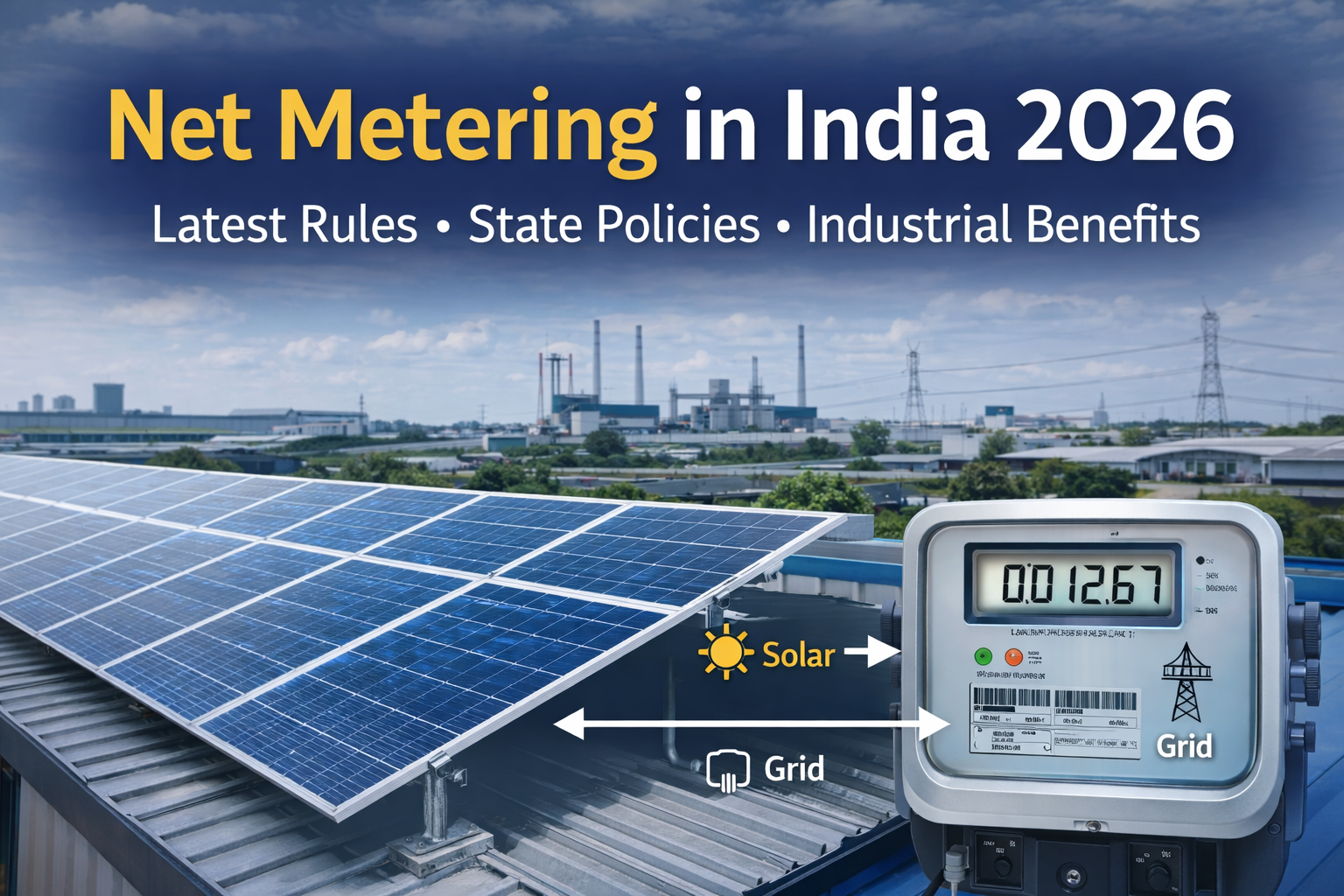
Net Metering in India
Net metering in India has become a key policy mechanism supporting the adoption of rooftop solar systems across residential, commercial, and industrial sectors. As India continues to expand its renewable energy capacity, net metering enables consumers to generate their own electricity while efficiently utilizing excess energy through grid interaction.
With rising electricity tariffs and increasing demand for clean energy, net metering provides a practical solution for businesses to reduce energy costs and improve sustainability. The policy allows solar system owners to export surplus electricity to the grid and receive credits, making solar investments more financially viable.
Government initiatives and regulatory frameworks across states have further strengthened net metering adoption, although policies vary based on state electricity regulations and system capacity limits.
What is Net Metering and How It Works?
- Net metering is a billing mechanism that allows solar system owners to offset their electricity consumption by exporting excess power to the grid.
- How it works:
- Solar panels generate electricity during the day
- Excess energy is exported to the grid
- A bidirectional meter records import and export units
- Consumers are billed only for net energy consumption
Net Metering vs Gross Metering
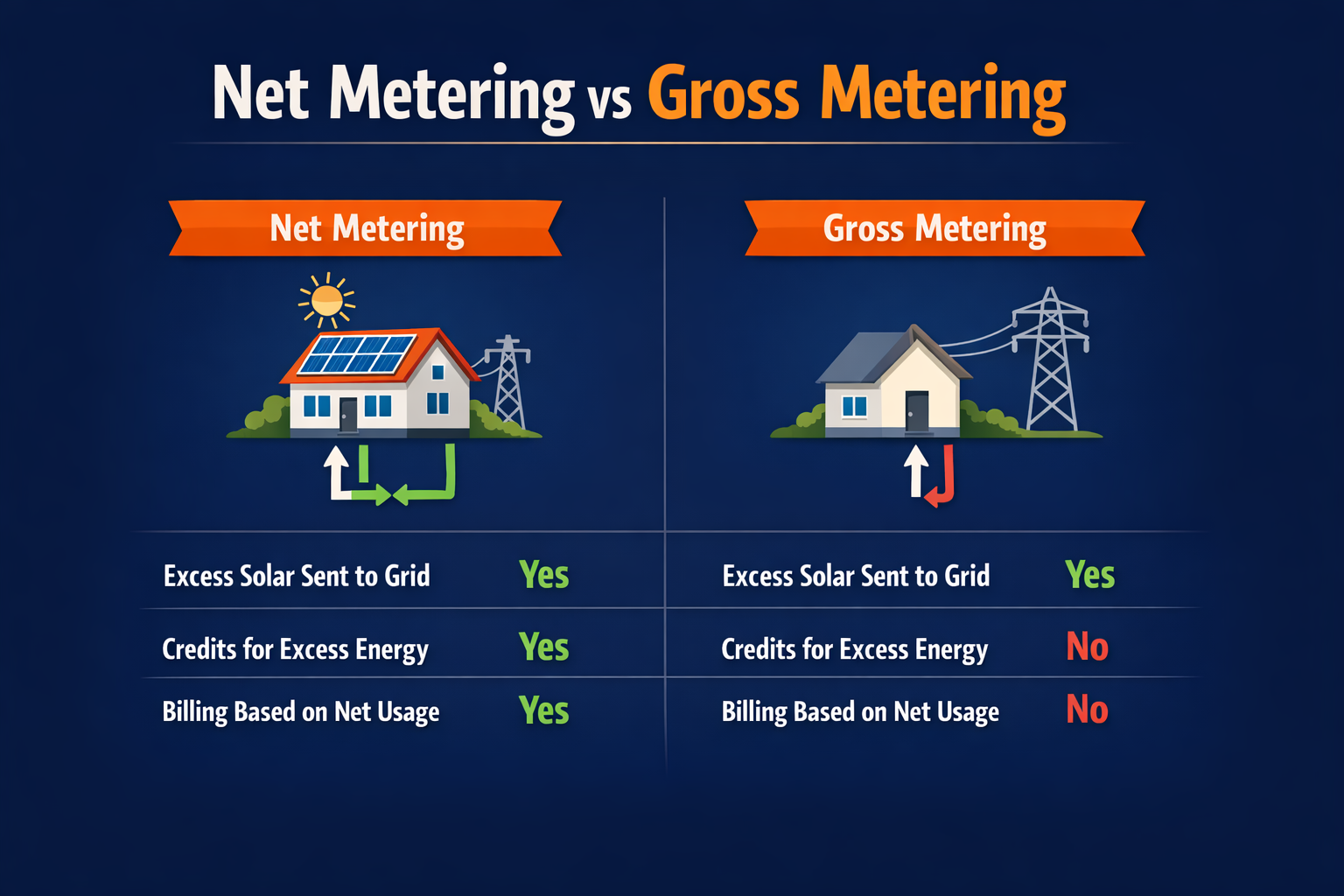
| Parameter | Net Metering | Gross Metering |
|---|---|---|
| Energy Usage | Self-consumption prioritized, excess exported | Entire energy exported to grid |
| Billing Mechanism | Consumer billed on net consumption (import minus export) | Consumer buys all electricity from grid separately |
| Savings Potential | Higher savings due to direct consumption offset | Lower savings, depends on feed-in tariff |
| Ideal Use Case | Industrial, commercial, and residential users | Utility-scale or large solar producers |
| Tariff Structure | Retail tariff offset | Fixed feed-in tariff decided by DISCOM |
| ROI | Faster payback period | Slower return on investment |
| Grid Dependency | Partial dependency | Full dependency on grid for consumption |
| Policy Availability | Widely available but state dependent | Limited and used in specific cases |
| Complexity | Moderate setup and approvals | Simpler billing but less beneficial |
| Financial Benefit | More cost-effective for businesses | Suitable for power producers, not consumers |
Latest Net Metering Rules in India 2026
- The regulatory framework for net metering is defined by central guidelines and implemented by state electricity regulatory commissions.
- Key updates:
- Net metering allowed for systems up to 500 kW or sanctioned load
- Above limits may fall under gross metering
- Mandatory DISCOM approval and grid synchronization
- Time-based settlement in some states
View More Guidelines Page on
Central Electricity Authority or MNRE ( Ministry of New and Renewable Energy )
State Wise Net Metering Policies in India
- Net metering regulations differ across states due to varying electricity policies.
- Examples:
- Gujarat: Strong rooftop solar adoption with simplified approvals - GEDA
- Maharashtra: Capacity limits and approval processes defined by MERC
- Tamil Nadu: Net feed-in policies with restrictions - TANGEDCO
- Rajasthan: Supportive policies for industrial solar - REAR
Eligibility Criteria for Net Metering in India
| Criteria | Description |
|---|---|
| Consumer Type | Available for residential, commercial, and industrial electricity consumers with a valid connection |
| System Type | Must be a grid-connected rooftop or ground-mounted solar system |
| Capacity Limit | Typically allowed up to 500 kW or sanctioned load, whichever is lower (varies by state) |
| Sanctioned Load Matching | Solar system capacity should not exceed the sanctioned electrical load |
| DISCOM Approval | Mandatory approval required from the local DISCOM before installation |
| Net Meter Installation | Bi-directional meter must be installed to measure import and export of electricity |
| Technical Compliance | System must comply with CEA safety standards and state electricity regulations |
| Connectivity Requirement | Must be connected to the grid through approved interconnection standards |
| Roof or Land Ownership | Consumer must have legal ownership or rights to install solar system |
| Agreement Signing | Net metering agreement must be signed with DISCOM before commissioning |
Net Metering Charges and Cost Structure in India - 2026
| Cost Component | Details |
|---|---|
| Application Fee | ₹500 to ₹5,000 depending on state DISCOM and system capacity |
| Net Meter Cost | ₹2,000 to ₹10,000 (some states subsidized or included in DISCOM charges) |
| Inspection Charges | ₹0 to ₹5,000 depending on DISCOM policies |
| Agreement Charges | Nominal or included in application fees |
| Grid Synchronization Cost | Usually included in installation, but may vary |
| Annual Charges | Some states impose fixed service or meter rent charges (~₹500–₹2,000/year) |
| Solar Installation Cost | ₹35–₹55 per watt (commercial scale, varies by technology and capacity) |
- Key Insights:
- Many states are reducing upfront charges to encourage rooftop solar adoption.
- Some DISCOMs now bundle net meter cost within project approval fees.
- Industrial-scale systems (100 kW – 500 kW) see economies of scale, reducing per watt cost.
- Time-of-Day (ToD) tariffs are being introduced in some states, impacting export value.
Net Metering Approval Timeline and Realistic Delays - 2026
| Stage | Official Timeline | Realistic Timeline (2026) | Remarks |
|---|---|---|---|
| Feasibility Approval | 7–15 days | 10–20 days | Depends on DISCOM load and feeder capacity |
| Installation | 7–30 days | 15–45 days | Based on project size and vendor efficiency |
| Inspection Request | 3–7 days | 5–10 days | Faster if documentation is complete |
| DISCOM Inspection | 7–15 days | 10–30 days | Common delay point due to scheduling |
| Net Meter Installation | 7–10 days | 10–25 days | Depends on meter availability |
| Final Activation | 3–7 days | 5–15 days | After agreement signing |
| Total Time | 30–60 days | 45–90 days | Realistic for most states |
Benefits of Net Metering for Industrial and Commercial Users
| Aspect | Benefits for Industrial and Commercial Users | Challenges and Policy Limitations |
|---|---|---|
| Cost Savings | Significant reduction in electricity bills through self-consumption and export credits | Savings depend on tariff structure and policy changes |
| ROI | Faster return on investment due to energy offset | Policy uncertainty can affect long-term financial planning |
| Energy Utilization | Efficient use of excess solar energy by exporting to grid | Export limits or caps in some states |
| Dependency on Grid | Reduced reliance on grid electricity | Still dependent on grid during low solar generation |
| Policy Support | Government policies encourage adoption | State-wise variations create confusion |
| System Size Flexibility | Suitable for medium to large industrial installations | Capacity restrictions may limit large projects |
| Environmental Impact | Supports sustainability and reduces carbon footprint | No major challenges, but compliance required |
| Operational Efficiency | Improves energy management and predictability | Approval delays from DISCOMs |
| Scalability | Can be expanded based on load requirements | Additional approvals required for expansion |
Why Choose Akuntha Projects for Solar EPC and Net Metering
Akuntha Projects Private Limited provides complete support for solar EPC projects along with net metering implementation. The company assists clients in system design, regulatory approvals, documentation, and grid integration.
With expertise in industrial solar installations and electrical infrastructure, Akuntha ensures that net metering processes are handled efficiently, minimizing delays and ensuring compliance with state regulations.
Frequently Asked Questions
What is net metering in India?
Net metering is a billing mechanism that allows solar system owners to export excess electricity to the grid and receive credits. These credits are adjusted against the electricity consumed from the grid, reducing the overall electricity bill.
Is net metering available in all states?
Net metering is available in most Indian states, but policies, capacity limits, and billing mechanisms vary depending on the State Electricity Regulatory Commission. It is important to check local DISCOM guidelines before installation.
What is the maximum limit for net metering in India?
As per central guidelines, net metering is generally allowed for systems up to 500 kW or the sanctioned load, whichever is lower. However, some states may have different limits based on their policies.
Can industrial consumers use net metering?
Yes, industrial and commercial consumers can use net metering, provided their system size and load meet state regulations. It is widely used in industries to reduce electricity costs and improve energy efficiency.
How much can a business save using net metering?
Savings depend on electricity tariff, solar system size, and energy consumption pattern. Typically, businesses can reduce their electricity bills by 30 to 70 percent through effective solar utilization.
What approvals are required for net metering?
The process includes application to DISCOM, technical feasibility approval, installation inspection, and signing of a net metering agreement. Final approval is required before grid synchronization
Is net metering better than gross metering?
Net metering is generally more beneficial for consumers as it allows direct savings through self-consumption. Gross metering is more suitable for power producers who sell all generated electricity to the grid.
Where can I find official net metering policies in India?
Official policies can be accessed through State Electricity Regulatory Commission websites and central authorities like MNRE and CEA, which provide updated regulatory guidelines.
Conclusion
Net metering plays a crucial role in promoting solar energy adoption in India by enabling efficient energy utilization and cost savings. For industrial and commercial users, it offers a practical pathway to reduce operational expenses and achieve sustainability targets.
With evolving policies and state-wise variations, understanding net metering regulations is essential before implementing a solar project. Partnering with experienced EPC companies ensures smooth execution and compliance.
