

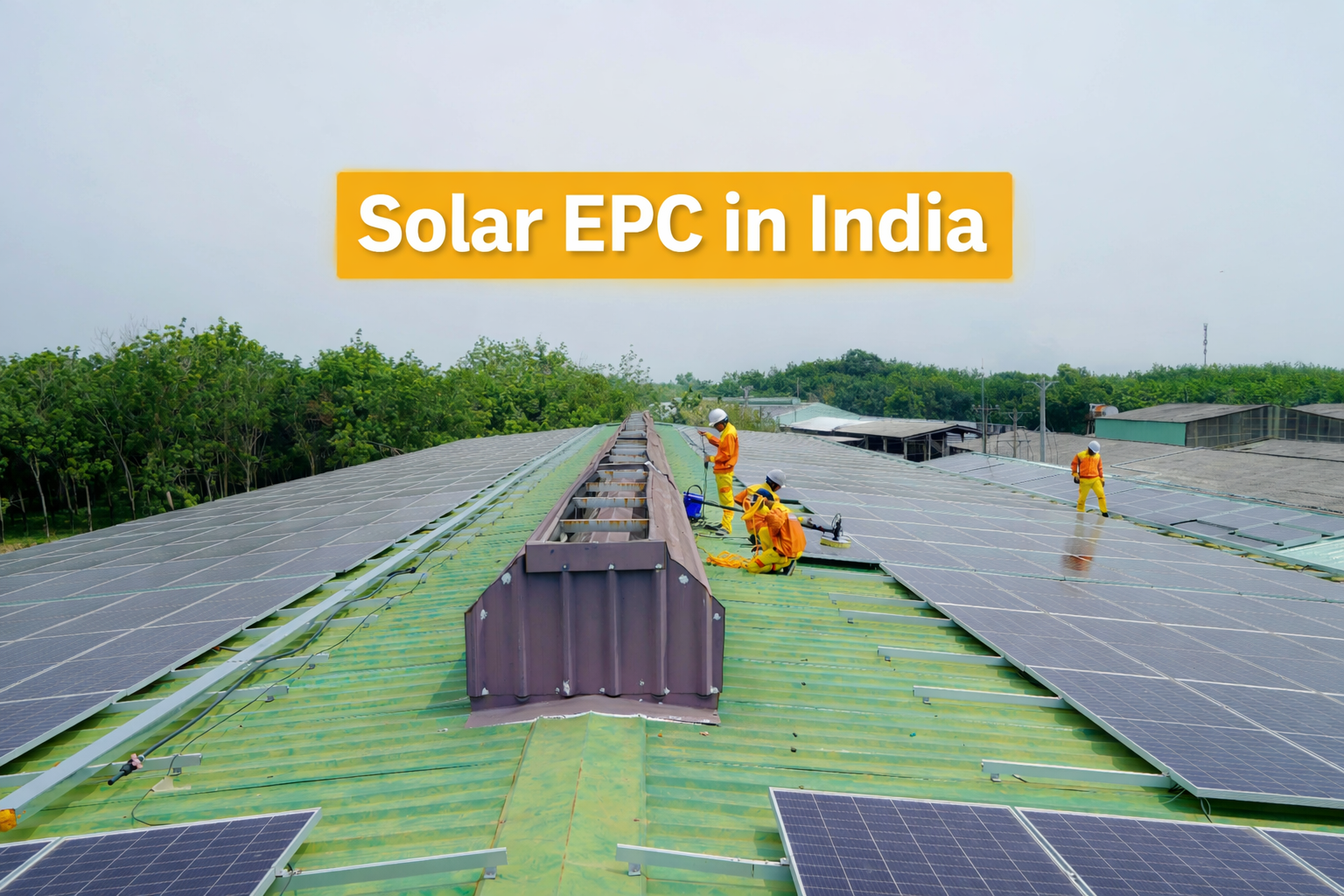
Why Solar for Gujarat Factories?
Solar EPC is a project delivery model used to execute solar power plants through a single responsible company. In this structure, one firm manages the complete process from engineering design to procurement of equipment and final construction and commissioning of the plant.
For industrial and commercial projects in India, this model simplifies execution and reduces coordination risks. Instead of dealing with multiple vendors separately, project owners work with one EPC partner who manages technical planning, equipment sourcing, installation and grid integration.
EPC stands for Engineering, Procurement and Construction.
- Engineering includes feasibility study, system design, structural layout and electrical planning.
- Procurement involves sourcing modules, inverters, structures and balance of system components.
- Construction includes civil work, installation, testing and grid synchronization.
How EPC Differs from an Installation Contractor
A traditional solar installation contractor typically handles only panel installation. Design responsibility and procurement decisions may be separate, and the project owner often manages coordination.
In contrast, a Solar EPC company takes end to end responsibility. It handles technical design, vendor coordination, construction management and performance assurance under one contract.
For example, if a manufacturing unit installs a one megawatt solar plant through separate vendors, delays or design mismatches may occur. Under the EPC model, the same company controls design and execution, reducing risk and improving efficiency.
Choosing Between: Traditional Contractor vs Solar EPC Model
| Aspect | Traditional Contractor | Solar EPC Model |
|---|---|---|
| Responsibility | Divided among multiple vendors | Single point responsibility under one contract |
| Risk Allocation | Risk shared and often unclear | Clearly defined responsibility with EPC partner |
| Execution Control | Project owner manages coordination | EPC company manages complete execution |
| Cost Transparency | Separate quotations from different vendors | Integrated project cost with defined scope |
| Timeline Accountability | Delays due to coordination gaps | Defined schedule with contractual milestones |
| Technical Integration | Design and installation may be disconnected | Engineering and construction fully integrated |
| Performance Guarantee | Limited or vendor specific | Performance parameters defined in contract |
Why EPC is Preferred for Industrial Projects
Industrial solar plants involve high capacity systems, grid approvals and financial evaluation. Industries prefer EPC because it offers single point accountability, defined timelines and integrated cost planning.
EPC contracts clearly define scope, performance parameters and delivery milestones. This provides financial clarity and reduces operational risk for factory owners and commercial developers.
Complete Solar EPC Project Lifecycle in India
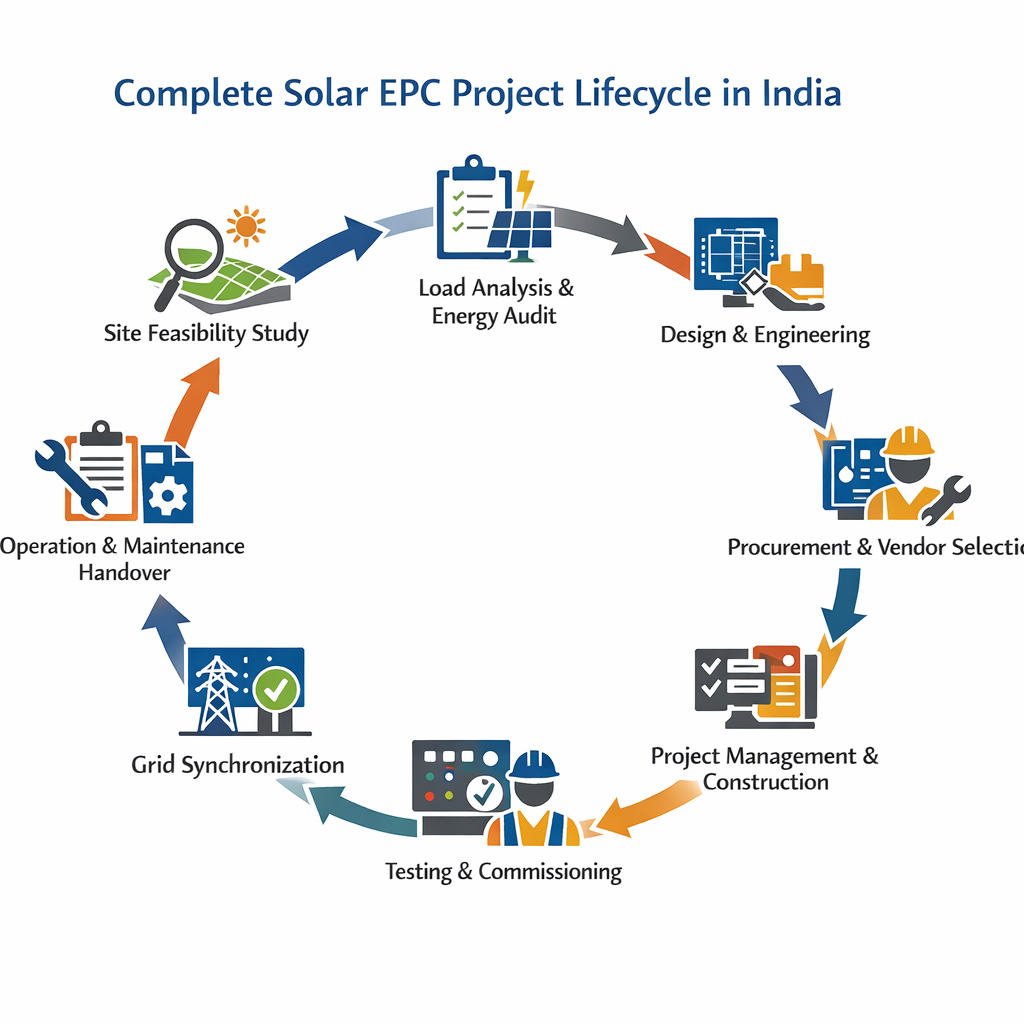
A structured EPC project follows a defined sequence. Each phase connects to the next and requires coordination with technical teams and regulatory authorities.
For more government on policy, formulates national electricity plans, and sets technical standards for power plants, grids, and safety. visit Central Electricity Authority
- Site Feasibility Study: The project begins with site inspection. The EPC team evaluates land availability, rooftop strength, shadow analysis, soil condition and grid proximity. For ground mounted plants, land conversion and right of way may be reviewed At this stage, preliminary discussions with the local DISCOM help confirm grid connectivity options.
- Load Analysis and Energy Audit: The industrial load profile is studied to understand energy consumption patterns. This includes peak demand, base load, seasonal variation and contract demand. This step ensures correct plant sizing and financial viability.
- Technical Design and Engineering: Detailed engineering drawings are prepared. This includes module layout, inverter configuration, cable routing, earthing system and protection design. Design must follow Central Electricity Authority safety standards and state regulatory norms.
- Procurement and Vendor Selection: Major components such as modules, inverters and transformers are sourced from approved manufacturers. Vendor selection is based on quality certification, warranty terms and performance record. Procurement planning also considers delivery timelines and supply chain reliability.
- Project Management and Construction: Civil foundation work, structure installation, module mounting and electrical wiring are executed. The EPC company supervises quality control, safety compliance and timeline management.
- Testing and Commissioning: Before energizing the plant, electrical testing is performed. Insulation testing, inverter calibration and protection relay checks are completed. Performance ratio is verified before final commissioning.
- Grid Synchronization: The plant is synchronized with the utility grid after inspection approval. Net metering or open access agreements are finalized depending on project structure.
- Operation and Maintenance Handover: After commissioning, the plant is handed over with documentation. Operation manuals, warranty documents and monitoring system access are provided. Long term maintenance planning is also discussed at this stage.
After mentioning net metering, visit Grid-India: State Electricity Regulatory Commission regulations.
Risks and Challenges: Solar EPC Execution Summary
| Risk Area | Key Concern | Mitigation Approach |
|---|---|---|
| Land and Structural Issues | Soil instability, uneven land, weak rooftop structure | Conduct detailed site survey and structural assessment before design finalization |
| Policy Changes | Revision in net metering, open access charges or state regulations | Monitor regulatory updates and plan financial models conservatively |
| Grid Connectivity Delays | Delay in DISCOM approval or limited transformer capacity | Initiate early coordination with DISCOM and confirm grid feasibility in planning stage |
| Module Supply Fluctuation | Price variation due to global supply or import policy changes | Secure procurement contracts early and evaluate approved vendors carefully |
| Engineering Errors | Incorrect sizing, protection gaps or design flaws | Implement detailed engineering review and follow Central Electricity Authority standards |
Choosing the right EPC Partner is critical for the success of any industrial solar project. Akuntha Projects Private Limited approaches Solar EPC with a structured engineering mindset and practical industry experience.
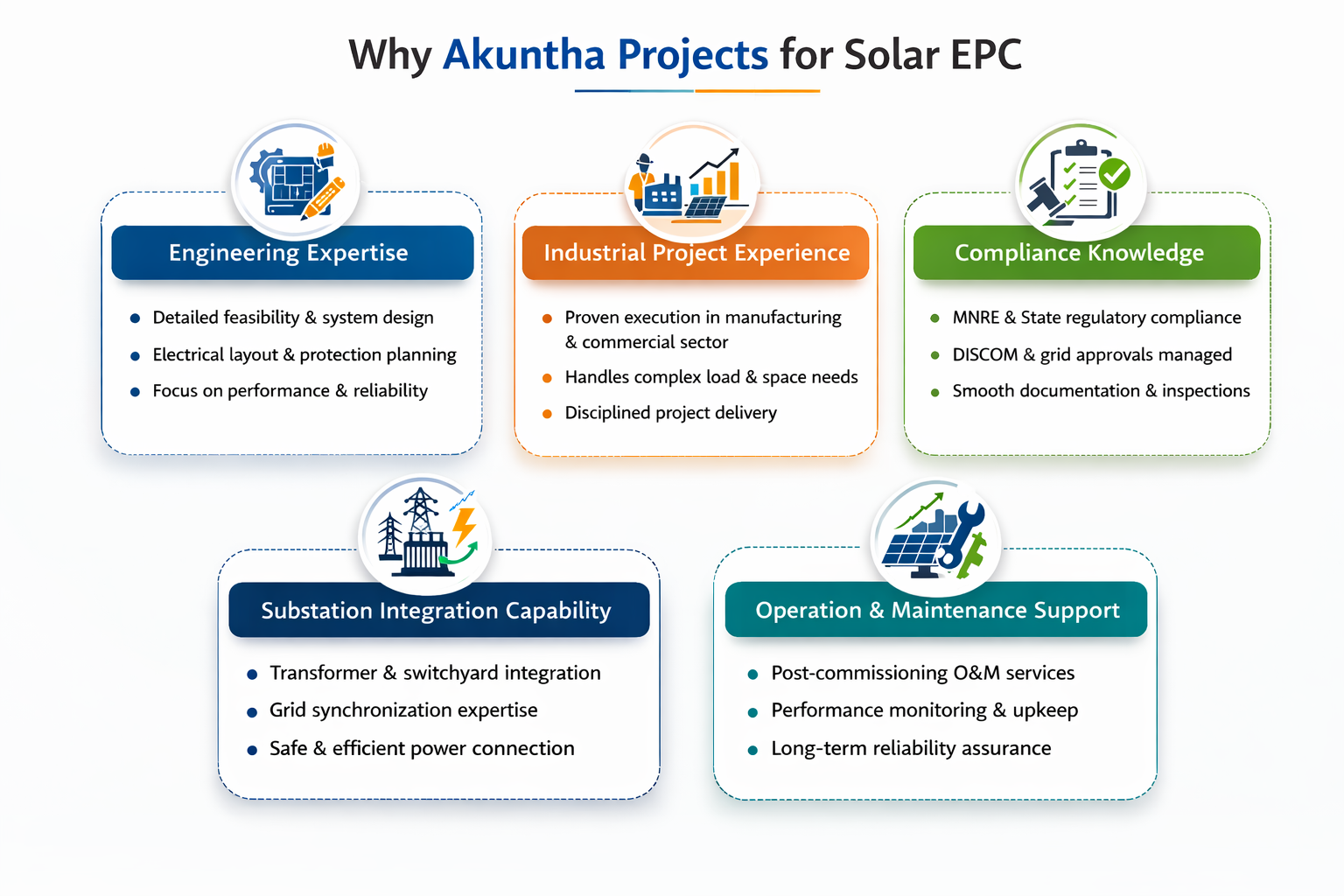
- Engineering Expertise: Akuntha follows detailed engineering processes that begin with feasibility assessment and extend through system design, electrical layout planning and protection coordination. Each project is designed with performance, safety and long term reliability in focus.
- Industrial Project Experience: Industrial facilities have complex load patterns, space constraints and compliance requirements. Akuntha’s experience in handling manufacturing and commercial infrastructure projects enables accurate planning and disciplined execution.
- Compliance Knowledge: Solar projects must align with MNRE guidelines, state electricity regulatory frameworks and DISCOM requirements. Akuntha ensures documentation, grid applications and inspection processes are handled professionally to avoid unnecessary delays.
- Substation Integration Capability: Large industrial solar plants often require transformer upgrades, switchyard planning and grid synchronization. Akuntha’s understanding of substation integration ensures that solar generation is safely and efficiently connected to the grid.
- Operation and Maintenance Support: Long term plant performance depends on proper monitoring and maintenance. Akuntha provides structured operation and maintenance planning to help industries protect their investment and maintain performance ratio over time.
FAQ's
What does EPC mean in solar projects?
EPC stands for Engineering, Procurement and Construction. In solar projects, it refers to a model where one company is responsible for designing the system, procuring equipment, constructing the plant and commissioning it. The EPC contractor manages the entire project lifecycle under a single contract.
What is included in a Solar EPC contract?
A Solar EPC contract typically includes site feasibility assessment, detailed engineering design, procurement of modules and inverters, civil work, installation, testing, commissioning and grid synchronization. It also defines scope of work, execution timelines, performance parameters and warranty responsibilities.
How long does a 1 MW industrial solar EPC project take?
Project duration depends on plant type, location and approval timelines. For a typical one megawatt ground mounted industrial plant, execution including design, procurement, construction and approvals may take approximately three to six months.
How much does industrial solar EPC cost per MW in India?
The cost per megawatt varies based on technology selection, land conditions and regulatory requirements. Capital cost benchmarks are periodically published by the Central Electricity Authority. Prices also fluctuate based on module market trends and policy changes. A detailed feasibility study provides more accurate project specific estimates.
Is Solar EPC better than the RESCO model?
Solar EPC is generally suitable for industries that prefer asset ownership and long term cost savings. RESCO is more suitable for businesses that want to avoid upfront investment and operate under a third party ownership model. The better option depends on financial goals and investment strategy.
What approvals are required for an industrial solar plant?
Approvals may include grid connectivity clearance from the local DISCOM, net metering registration or open access approval depending on project configuration. Compliance with state electricity regulatory guidelines and technical standards is mandatory before commissioning.
Can EPC companies provide substation integration, O & M services after commissioning?
Yes. For medium and large scale projects, EPC scope can include transformer installation, switchyard development and grid synchronization support. Many EPC companies also offer operation and maintenance services after commissioning to ensure long term performance and system reliability.
